
-
Dental Practice
Legionella Risk Assessment
Ensure water safety, regulatory compliance, and peace of mind with tailored Legionella risk assessments designed specifically for dentists.
Made for dental practices
Legionella control is a critical aspect of patient and staff safety in any dental practice. Water systems, especially Dental Unit Water Lines (DUWLs), can be vulnerable to bacterial growth if not properly monitored and maintained. That’s why a thorough and compliant risk assessment is essential—not just to meet legal obligations, but to maintain trust and safety within your practice.
At The First Principle, we specialise in delivering Legionella risk assessments designed specifically for dental environments. Our experienced consultants evaluate your entire water system, identify potential hazards, and provide clear, actionable recommendations in line with HTM01-05, HTM04-01, and ACoP L8 standards. We ensure your practice not only meets all regulatory requirements but operates with complete confidence in its water hygiene protocols.
Why dental practices choose our compliance pack
- Bespoke risk assessment reports
- Compliant with ACoP L8, HTM01-05, HTM04-01, and HSG274 regulations
- Full inspection of hot and cold water systems
- Assessment of Dental Unit Water Lines (DUWLs)
- Schematic drawings and photographic evidence
- Clear risk ratings and practical recommendations
- Evaluation of monitoring programme and written scheme
- Water sampling and UKAS-accredited lab testing for Legionella and TVC
Legionella bacteria can pose serious health risks, particularly in healthcare environments like dental practices. Dental Unit Water Lines (DUWLs) can harbour biofilms that create ideal conditions for bacterial growth. Controlling this risk is not just a legal duty but essential for patient and staff safety.
Regular Legionella assessments help identify vulnerabilities in your water systems and ensure your practice complies with HTM01-05, HTM04-01, and other regulatory guidelines.
Our experienced consultants begin with a detailed site survey of your dental practice, inspecting all water systems, including taps, sinks, and DUWLs.
You will receive:
- A full written report with risk ratings
- A schematic drawing of your water system
- Practical recommendations for corrective actions
- Photographic evidence
- Monitoring programme evaluation
We also assess current management practices to ensure proper ongoing control.
Where needed, we perform on-site water sampling for Legionella and Total Viable Count (TVC), sent to an independent UKAS-accredited laboratory.
Results are analysed, and we:
- Interpret lab data clearly for you
- Issue emergency alerts if results exceed thresholds
- Provide next-step recommendations
- Help update your compliance documentation
This ensures your practice is both legally protected and operationally safe.
Did you know?
Dental Unit Water Lines - Microbiological monitoring HTM01-05 Paragraph 19.68 states that:
“All microbiological measurements should be by approved methods and/or be carried out by United Kingdom Accreditation Service (UKAS)-accredited laboratories.
Dip slides are not acceptable.“
The First Principle can undertake on-site sampling of your water systems including dental unit water lines (DULWs) for Legionella and TVC (drinking water) using an independent UKAS Accredited Testing Laboratory. We will receive and interpret the laboratory test results and prepare recommendations for remedial action (including emergency reporting of elevated results).
Get your practice compliant in 3 simple steps
Step 1 - Request a quote
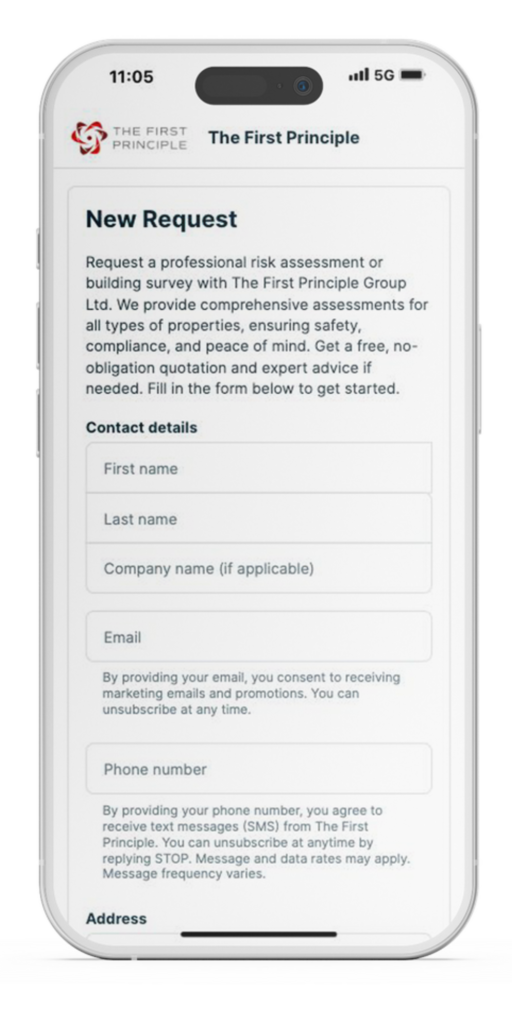
Get in touch with us to discuss your dental practice and receive a tailored quote for your Legionella risk assessment. We’ll guide you on what’s required based on your setup and legal obligations.
Step 2 - We visit your premises
Our qualified consultant will visit your practice to carry out a full risk assessment. This includes inspecting all relevant water systems, assessing DUWLs, and collecting samples if necessary for UKAS-accredited lab testing.
Step 3 - Get your reports
You’ll get a comprehensive, easy-to-understand report including risk ratings, schematic drawings, photographic evidence, and a clear action plan to maintain compliance and protect your patients and staff.
Why choose the first principle?
At The First Principle, we specialise in water hygiene services tailored for dental practices. With deep expertise in HTM and HSE guidance, we ensure you meet your compliance duties without stress or confusion. Our assessments are practical, detailed, and easy to action — so you can stay focused on patient care.

Expertise
All assessments are conducted by City & Guilds WH004 trained consultants and members of the Water Management Society.

Compliance
We strictly follow HTM01-05, HTM04-01, ACoP L8, and HSG274 guidelines — ensuring your practice is audit-ready at all times.

Clarity
Our reports are designed for real-world use: visual, straightforward, and backed by clear recommendations.

Trust
We’ve supported dental practices across the UK with 5-star rated service, and always aim for 100% satisfaction.
Established company
When to contact The First Principle
- Opening a new dental practice
- Annual compliance review
- Staff or management changes
- Refurbishments or plumbing work
- Dental equipment upgrades
- Poor water test results
- CQC inspections preparation
- New regulations or guidance updates
- Patient or staff concerns
Stay compliant
Ensure your dental practice remains compliant, safe, and trusted by both patients and regulators.
Our expert consultants specialise in risk assessments tailored for dental environments — including dental chairs, DUWLs, and water systems.
Your questions answered
Common questions
Do dental practices need to carry out a legionella risk assessment?
In accordance with the Health Technical Memorandum (HTM01-05), dental practices ought to engage an external specialist to aid in fulfilling the recommendations outlined in Section 3 of the guidance for dental unit water lines. This necessity arises from the expertise demanded in this specialised field, as well as the need for specialist knowledge of Legionella and other waterborne organisms.
Although dental practices might be capable of carrying out some control measures for dental unit water lines themselves, such as routine flushing and disinfection, it is advisable that they employ an external specialist to perform the risk assessment and provide guidance on suitable control measures.
To summarise, dental practices should engage an external specialist to carry out the risk assessment and offer advice on appropriate control measures for dental unit water lines and domestic hot and cold water systems, due to the expertise needed in this specialised field. It is crucial that the individual conducting the risk assessment is trained and competent to do so.
Why do dental practices need legionella risk assessments?
Dental practices, like all businesses, have a moral and legal requirement to ensure the safety of their employees and the public. A legionella risk assessment helps identify potential risks associated with the water system in a dental practice, including the potential for Legionnaires’ disease to be contracted by patients or staff. The Health and Safety Executive’s Approved Code of Practice (ACOP) L8, as well as the HSE guidance documents HSG 274 Parts 2 and 3, Health Technical Memorandum HTM 04-01, and HTM 01-05, all require businesses to carry out a risk assessment that identifies all foreseeable risks associated with their water system. The risk assessment must include all water systems and dental equipment, including dental lines, ultrasonic scalers, cavitrons, airflows, air purifiers, and any other equipment that may create aerosols or that water flows through. Failure to conduct a legionella risk assessment in a dental practice can result in legal action and serious harm to patients or staff.
How often do I need to review my dental practice legionella risk assessment?
The frequency of reviewing the legionella risk assessment in a dental practice depends on a number of factors, including the condition of the practice water system, management system, and other factors. The risk assessment should be reviewed regularly enough to keep it up to date and ensure that control measures remain effective. Dental practices should refer to their competent person risk assessment, which should clearly advise when the risk assessment should be reviewed.
It is important to note that the risk assessment should not only be reviewed when the dental practice receives a call from the CQC. According to the Health and Safety Executive’s Approved Code of Practice (ACOP L8), the risk assessment is a living document that must be reviewed regularly and specifically whenever there is reason to suspect it is no longer valid. This may result from changes to the water system or its use, changes to the building in which the water system is installed, the availability of new information about risks or control measures, the results of checks indicating that control measures are no longer effective, changes to key personnel, or a case of legionnaires’ disease/legionellosis associated with the system.
In summary, dental practices should ensure that they have a competent person risk assessment in place, which clearly advises when the risk assessment should be reviewed. They should also be aware of the factors that may require a review of the risk assessment, and ensure that the assessment is revised immediately when necessary to protect the health and safety of their patients and staff, rather than waiting for a call from the CQC.
What are the requirements and qualifications for a responsible person or their deputy in a dental practice?
In line with the HTM guidance for dental practices, the registered manager is considered to be a responsible person. As part of their role, they should attend suitable training to ensure that they have the necessary knowledge and skills to carry out their responsibilities effectively. Basic awareness training is not considered to be adequate for someone who is nominated as a responsible person or their deputy. Instead, more comprehensive and in-depth training should be pursued to equip them with the expertise needed to maintain a safe and compliant environment within the dental practice.
What is a legionella written scheme of control for dental practices?
A written scheme of control for dental practices is a document that outlines how the practice will manage and control the risks associated with legionella and other bacteria in its water systems. The CQC expects all dental practices to have a site-specific written scheme of control in place to ensure compliance with legal requirements and ensure patient safety. All of our legionella compliance packs for dental practices include a site-specific written scheme of control draft and bespoke record keeping system for their practice.
CQC Dental Mythbuster 5: Legionella and dental waterline management
https://www.cqc.org.uk/guidance-providers/dentists/dental-mythbuster-5-legionella-dental-waterline-management
What checks must dental practices do internally to manage the risk of legionella in their water system?
The checks required for each dental practice will vary depending on the specific water systems present in the practice. However, standard checks may include weekly flushing of infrequently used water services, monthly temperature monitoring of hot and cold water outlets, and quarterly cleaning of showerheads. These checks are intended to prevent the growth of legionella bacteria by ensuring that water is not allowed to stagnate and that temperatures are kept at safe levels.
It is important to note that these checks are not exhaustive, and there may be other checks that are necessary depending on the specific water system in a dental practice. For this reason, it is important for dental practices to refer to their site-specific legionella risk assessment, which should identify all water systems present in the practice and set out the control measures required to manage the risk of legionella.
Do dental practices need to take dip slides from their dental lines?
The Health Technical Memorandum (HTM 01-05) guidance does not advocate the routine use of dip slides. Instead, dental practices should have a system in place to manage the level of microbiological activity in their dental unit waterlines. This system should include a mixture of control measures, such as regular and proactive disinfection of the dental unit waterlines, flushing of lines to prevent water stagnation and biofilm formation, and other measures outlined in HTM 01-05.
It is important to note that the product used for routine disinfection of dental unit waterlines MUST be approved by the chair manufacturer (for example, Belmont, Kavo, A-dec, Stern Webber). Using a product that is not approved by the manufacturer may invalidate the warranty and could potentially damage the dental unit. Therefore, it is essential to ensure that only approved products are used for routine disinfection.
If you decide to deviate from the advice provided by HTM 01-05 and the chair manufacturer, you should prove that the control measures you have adopted are effective. Regular sampling could be used to demonstrate that control is in place. Although many suppliers advocate using dipslides or HPC samplers, HTM considers those methods unreliable and advises that UKAS-accredited methods of testing, such as TVC sampling, should be used.
Microbiological sampling may provide some useful information about water quality, but the data is limited to the specific date and time when the sample was collected. Rather than relying solely on testing, proactive periodic disinfection should be used to maintain water quality.
Should routine water sampling be carried out in a dental practice to monitor for legionella?
Routine water sampling for legionella is not usually required in a dental practice, unless there is doubt about the efficacy of the control regime or it is known that recommended temperatures, disinfectant concentrations, or other precautions are not being consistently achieved throughout the system. Sampling may be appropriate in certain circumstances, such as when water systems are treated with biocides or in high-risk areas. If sampling is carried out, it should be in accordance with BS 7592.